

Real Estate Website Development and Design for Agencies, Brokers and Developers
Property listing websites, luxury showcases and real estate apps that put the right homes in front of buyers and turn their interest into booked viewings.
A good fit if
- Your listings live on the portals and your own site adds nothing
- You sell a handful of high-value homes and the site looks like a template
- You are launching a development and need a site before the first viewing
- Agents re-enter the same listing in three places every week
Buyers start on the portals. The serious ones come to your site to decide whether they trust you. A real estate website has two jobs: show the property better than a portal can, and make the next step, a viewing or a call, impossible to miss.
Services
Real estate website development services
From a one-page villa showcase to a searchable listing site with an agent back office.
Property listing website design
Search and filters by area, price, bedrooms and status, listing pages with galleries, floor plans and maps, and a shortlist buyers can come back to.
Luxury real estate websites
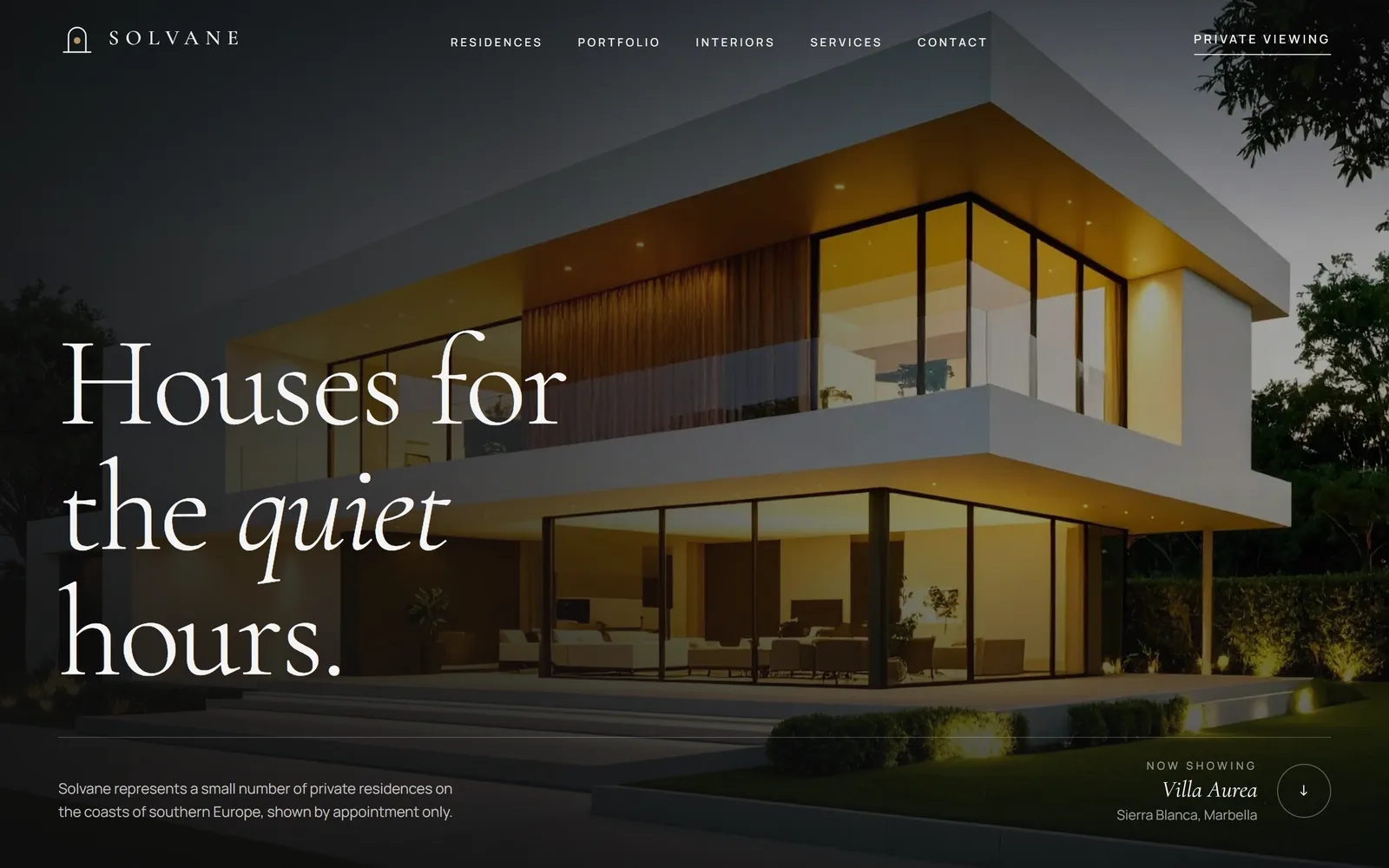
Fewer homes, told properly: full-bleed photography, residence details, a private enquiry route and a pace that matches the price.
New development and project sites
A site for a single scheme with unit availability, specifications, location and a registration form for launch news.
Agency and broker websites
Team profiles, area guides, valuation requests and listings managed in a CMS your agents can update without calling a developer.
Listing feeds and CRM connections
Listings pulled from your CRM or an MLS or IDX feed where your market uses one, so a price change happens once and enquiries reach the right agent.
Real estate app development
iOS and Android apps for buyers, tenants or agents, built in React Native or Flutter and sharing the same data as the website.
What buyers need
Real estate website design that sells property online
Buyers judge the home and the agent at the same time. The design has to win both.
Photography that does the selling
Large images served in modern formats at the right size for each screen, so a forty-photo gallery does not stall on a phone.
The facts, up front
Bedrooms, floor area, grounds, status and price where your market shows it. Buyers filter on facts before they fall for a kitchen.
A viewing one step away
Arrange a viewing, request details or call the agent from every listing, with the property already filled in on the form.
Signals that build trust
Who you are, which areas you know, what you have sold or let, and who will actually pick up the phone.
Area guides worth reading
Neighbourhood pages with schools, transport and the feel of the streets. They help buyers decide and give Google pages to rank.
Search
Real estate SEO: winning the searches the portals do not own
You will not outrank the big portals for 'houses for sale'. You can win the specific searches serious buyers make.
Area and property type pages
'Sea view villas in [area]' or 'office space near [station]' are smaller searches made by people who know what they want.
Listing schema and clean URLs
Structured data for each listing and for the agency, readable URLs, and sold or let homes handled properly instead of turning into error pages.
A Google Business Profile for each office
Each branch with its own profile, category, photos and reviews, and a matching office page on the site.
Speed with heavy galleries
Lazy-loaded images, responsive sizes and pre-rendered pages, so photo-heavy listings still pass Core Web Vitals.
Leads you can trace
Every enquiry tagged with the listing and the source, so you know which channel sends buyers and which sends browsers.
How it runs
How we build a real estate website
- 01
Map the inventory
How many listings, where they come from, how often they change and who updates them.
- 02
Design the listing page first
The page buyers spend the most time on is designed before the home page, with real properties.
- 03
Build, connect and load
Search, feeds, CMS, forms and CRM connected, with live listings loaded for you to review.
- 04
Launch and measure
Redirects, analytics, enquiry tracking and Google Business Profile updates in place on launch day.
Cost
How much does real estate website development cost?
Real estate website development cost depends mostly on how listings get onto the site. We quote a fixed price after a scoping call, and these are the things that move it.
Get a fixed quote→| What moves the price | Why |
|---|---|
| Showcase or searchable listings | A one-page showcase for a few homes is a smaller build than search, filters and saved properties across hundreds. |
| Where listings come from | Entering homes in a CMS is simple. Syncing from a CRM, MLS or IDX feed needs integration work and careful testing. |
| Offices and agents | Each branch and agent profile adds pages, profile data and enquiry routing. |
| Maps, floor plans and tours | Interactive maps, plan viewers and embedded virtual tours each add build time. |
| Website, app or both | A buyer app for iOS and Android is its own project, though it can share the website's data and back end. |
| Content and photography | Area guides and listing copy written by us are scoped separately from the build. |
Live proof
Luxury real estate website example we have shipped.
Tools we use for this
- Next.js
- React
- Tailwind CSS
- GSAP
- Sanity
- PostgreSQL
- Mapbox
- React Native
- Flutter
- Vercel
FAQ
Real estate website development questions
It depends on the number of listings, where they come from and what buyers can do on the site. A one-page showcase for a few luxury homes is a much smaller build than a searchable listing site synced from a CRM or MLS feed with agent profiles and saved searches. We give a fixed quote after a short scoping call, and the start a project form lets you choose a budget range so the conversation starts at the right size.
It is the design and build of a website for an agency, broker, developer or property owner, plus the systems behind it: listing management, search and filters, maps, enquiry forms and connections to your CRM or listing feed. A brochure site tells people you exist. Real estate website development makes the listings themselves the product, keeps them up to date without double entry, and routes every enquiry to the agent who can answer it.
Listings with large photos, key facts, floor plans and a map; search and filters for area, price, bedrooms and status; a clear way to arrange a viewing or call an agent from every listing; agent and office pages; area guides; and a valuation or contact form for sellers. Add structured data for listings, fast image loading and analytics that tie each enquiry to the listing it came from. Everything else is decoration.
Design the listing page first, because that is where buyers decide. Put the facts buyers filter on near the top, keep the gallery fast, and make Arrange a viewing visible without scrolling on a phone. Pre-fill the enquiry form with the property so the buyer types as little as possible. Then remove anything that competes with that action. Good real estate website design feels quieter than a portal, not busier.
Usually, yes. Most property CRMs and listing feeds offer an API or a regular export, and we build the connection so new listings, price changes and status updates appear on the site without anyone retyping them. Where your market uses MLS or IDX data, the rules for displaying it vary by board, so we check those at the start. If you only hold a few homes, a simple CMS is often the better choice.
Fewer homes, told better. Buyers at the top of the market are not filtering through hundreds of results; they want to feel the house before they ask about it. A luxury real estate website uses full-bleed photography, residence details with floor area and grounds, a calm editorial layout and a private enquiry route instead of a generic contact form. It should feel like a private introduction, with a viewing one step away.
Real estate app development cost depends on who the app is for and what it does. A buyer app with search, saved homes and alerts is a different size of project from an agent app with listing management, viewings and CRM sync. Building in React Native or Flutter keeps iOS and Android on one codebase, and sharing a back end with your website avoids paying for the same data twice. We quote a fixed price after scoping.
A website first, in almost every case. It is how buyers find you through search, it works on every device without a download, and it is cheaper to change while you learn what buyers use. An app makes sense once you have repeat users, such as tenants, investors or agents, who will open it every week. Build the website on a back end the app can share later, and the second step costs far less.
Not for broad searches like 'houses for sale', and it is rarely worth trying. An agency site can rank for specific searches the portals cover thinly: neighbourhood guides, property types in a named area, new developments, and your own brand plus area. Each needs its own page with real local detail. A complete Google Business Profile for each office helps you appear in the map pack for agent searches nearby.
Yes. Kavion is a small senior team based in India, working remotely with clients in the US, UK, Canada, Australia and India. There are no account managers in between: the people who design and build your site are the people on your calls. We plan overlap with your working day for reviews, share preview links you can click through, and reply within one business day.