

Hire Dedicated Developers in India Who Work as Part of Your Team
A senior developer from our own team, working on your product alone, in your tools and your sprint. No bench, no account manager, no handover to a junior after the sales call.
A good fit if
- You need senior hands on your product every week, not a one-off project
- Hiring in-house is slow and a bad hire is expensive to undo
- An offshore vendor once swapped your developer mid-sprint and you lost months
- You want to outsource web development to India without layers of managers
Kavion is a small senior team in India, not a staffing firm. When you hire a dedicated developer from us, you get one of the engineers who builds our client work and our own product, and we take on only a few of these engagements at a time. If nobody suitable is free, we say so on the first call.
The model
The dedicated development team model, explained
You book a developer's time and focus. You direct the work. We make sure they are good at it.
One developer, one product
Your developer works on your codebase and nothing else for the hours you book. They learn your domain, your users and your quirks, which is the whole point of a dedicated development team.
You set the priorities
Work comes from your backlog, not from a contract scope. Change direction on Monday and the developer changes with you, without a change request or a new quote.
Senior by default
We do not hire juniors to fill seats. Your developer has shipped production work and can make architecture calls, review pull requests and push back when a ticket does not make sense.
Backed by the rest of the team
When your product needs AI, mobile, DevOps or design help, the specialist is one message away, and their time can be added to the engagement when you need it.
When a fixed-price project fits better
If your scope is clear and has an end date, a fixed-price project is usually simpler and less work for you to manage. We will tell you when that is the case.
Engagement
What happens after you hire dedicated developers from India
The same rules as a good in-house hire: they work where your team works, and you see progress every week.
Onboarded into your Slack, Jira and GitHub
Your developer joins your workspace, your board and your repositories under accounts you create and control. Standups, tickets and code reviews happen where your team already works.
A demo every week
Every week you see working software, not a status report: what shipped, what is next and what is blocked, on a short call or a recorded walkthrough.
Overlap with your working day
We plan overlap with your working day for standups, reviews and quick questions, and keep the rest async with written handover notes, so nothing waits on a call.
You own everything
Code, repositories, cloud accounts, domains and design files are yours from the first commit. Nothing sits in a Kavion account that you would need to ask for later.
Flexible notice
Products change. You can scale hours down, pause or end the engagement with a reasonable notice period agreed in the contract, and we hand over cleanly either way.
Honest about capacity
We are a small team, so dedicated slots are limited. We would rather start later with the right developer than staff your product with whoever happens to be free.
Clients abroad
Outsource web development to India from the UK, US or Australia
Most teams who hire Indian developers sit in another country. The setup stays the same wherever you are. Only the calendar changes.
Hiring Indian developers from the UK
Contracts set up for a UK business, intellectual property assigned to your company and standups planned inside your working day. A dedicated developer extends a small in-house team without adding to your headcount.
Hiring Indian developers from the US
The time difference becomes a handover: your developer leaves written progress and pull requests ready for review, and we schedule overlap for the calls that need to be live.
Hiring Indian developers from Australia
The same arrangement: agreed overlap for standups and demos, async updates in Slack for everything else, and a contract written for an Australian business.
Canada and India too
We also work with clients in Canada and across India. The terms, the tools and the weekly rhythm do not change with the country.
Choosing an offshore development company in India
Ask who will write the code, whether you can speak to them before signing, who owns the repositories and what happens if the developer leaves. A partner worth hiring answers all four without hesitating.
How it runs
How to hire a dedicated developer from Kavion
- 01
Tell us what you are building
A short call about your product, your stack and the gap you need filled. We reply to every enquiry within one business day.
- 02
Meet the developer
If the right person is free, you talk to them directly before anything is signed. If not, we tell you when someone will be.
- 03
Onboard into your tools
Access to Slack, Jira and GitHub under your accounts, a walkthrough of the codebase and a first ticket small enough to prove the whole loop.
- 04
Ship every week
Weekly demos, a monthly check on whether the hours and focus are still right, and changes to the arrangement when your product needs them.
Cost
How much does it cost to hire dedicated developers in India?
There is no rate card here, because the right arrangement depends on your product. These are the factors that set the monthly fee, which we confirm as a fixed quote before anyone starts.
Get a fixed quote→| What moves the price | Why |
|---|---|
| Full time or part time | A developer on your product every working day is a larger monthly commitment than a set number of hours each week. |
| Skill set | Full stack web work, mobile apps, AI engineering and DevOps draw on different specialists, and the quote reflects which ones your product needs. |
| Length of commitment | A longer engagement lets us plan the developer's time around your roadmap. A short burst of work is scoped and priced as exactly that. |
| State of the codebase | Joining a clean, tested repository is quicker than inheriting one with no docs and no tests, and the first weeks of onboarding reflect that. |
| Meetings and overlap | More live hours in your working day, more meetings and any on-call expectations take time away from building, so we agree them up front. |
| Extra hands from the team | Design, QA, DevOps or AI support from the wider team can be added to the engagement when your product calls for it. |
Live proof
Built by the team you would hire from we have shipped.
Our product
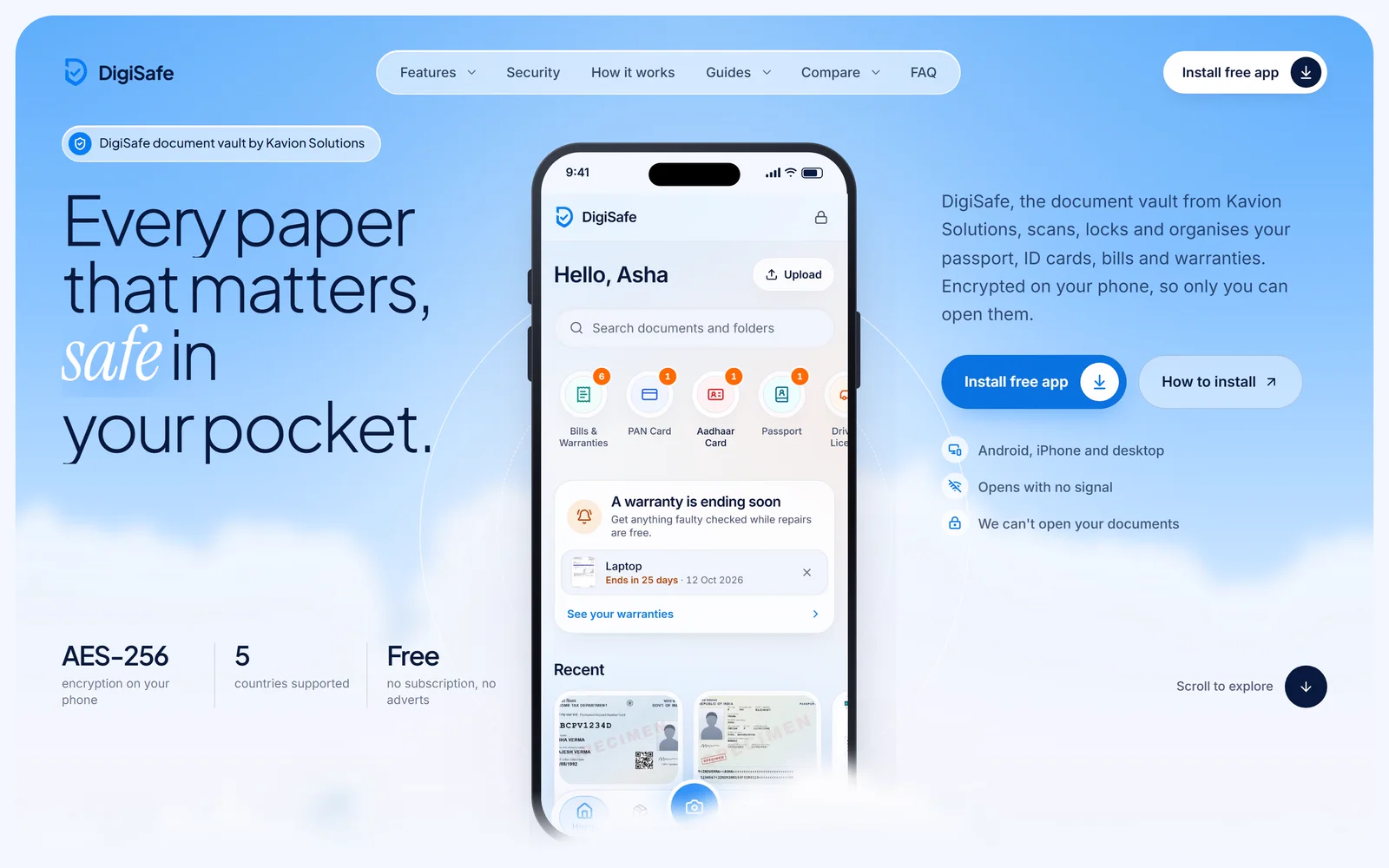
DigiSafe
Our own free, end-to-end encrypted document vault, installable on any phone or computer.
Read the case study →
Healthcare
Sanavyr
A calm, scroll-animated website for a multi-specialty clinic.
Read the case study →
Real estate
Solvane
An editorial one-page website for luxury villas, agencies and private brokers.
Read the case study →Tools we use for this
- Next.js
- React
- TypeScript
- React Native
- Flutter
- Python
- Django
- FastAPI
- PostgreSQL
- AWS
- Google Cloud
- Azure
FAQ
Questions before you hire dedicated developers in India
Yes, and for a startup it is often the sensible route. A dedicated developer gives you senior engineering capacity without the cost and delay of a full hire, and the work follows your backlog as the MVP changes shape. If your MVP has a fixed scope and a clear launch date, a fixed-price project may suit you better, and we will say so. Either way you own the code and accounts from day one, so nothing stops you hiring in-house later and handing the product over.
Start with a short call about what you are building, your stack and where the gap is. We tell you honestly whether the right developer is free. If they are, you speak to them before signing anything. Then we agree hours, overlap and a fixed monthly fee, set up access to your Slack, Jira and GitHub, and the developer starts on a first ticket. You can send the details through the start a project form, and we reply within one business day.
With us, it depends almost entirely on whether the right developer is free, because we are a small team and do not keep a bench of idle people waiting. When someone suitable is available, the steps are short: a call, a conversation with the developer, a contract and access to your tools. When nobody suitable is free, we tell you on the first call when that will change, rather than offering whoever happens to be idle. Recruiting an in-house developer usually takes far longer than either route.
It depends on how you outsource. A fixed-price project is priced on scope: pages, features, integrations and design. A dedicated developer is priced as a monthly fee based on hours, seniority and skill set. Freelancers and large outsourcing firms each price differently again, and the cheapest quote often hides the cost of rework or a junior doing the build. We do not publish a rate card. We give a fixed quote after a short scoping call, so you know the number before any work begins.
There is no universal minimum, and anyone who quotes one without asking about your product is guessing. The real floor is the smallest piece of work worth doing properly: a focused feature, an audit or a set number of developer hours each month. At Kavion you can start with hourly, on-demand work for a small task, a fixed-price project for a defined build or a dedicated developer for ongoing work. Tell us your budget range on the first call and we will say plainly what it can cover.
Yes, when you choose the partner carefully. India has a deep pool of experienced engineers, and a good team lets a startup build faster without a full in-house payroll. The risks are real too: junior developers sold as seniors, staff swapped mid-project, code kept in the vendor's accounts and weak communication. You avoid them by talking to the actual developer before signing, insisting on owning your repositories and cloud accounts, and asking for weekly demos of working software rather than status reports.
It is an arrangement where one or more developers work only on your product for an agreed number of hours, under your direction, while the provider handles their employment, equipment and continuity. You manage the backlog and priorities as you would with your own staff. It differs from a fixed-price project, where the vendor commits to a defined scope, and from freelancing, where one person juggles several clients. It suits products with ongoing, changing work rather than a single build with an end date.
Look past the portfolio slide. Ask who will write your code and talk to that person before signing. Check that repositories, cloud accounts and domains will sit in your name. Ask how they handle a developer leaving, how often you will see working software and who you contact when something goes wrong. A reliable offshore development company in India answers all of that plainly and puts it in the contract. Be wary of anyone promising a large team within days at a rate that looks too good.
Yes. We work remotely with clients in the US, UK, Canada and Australia as well as India. Contracts assign the intellectual property to your company, invoicing is set up for an overseas client, and the developer works inside your own tools rather than ours. We plan overlap with your working day for standups, reviews and demos, and keep everything else async with written updates, so the time difference turns into progress waiting for you rather than delays.
You own everything: code, repositories, cloud accounts, domains, designs and documentation, from the first commit. We work inside accounts you create, so there is nothing to transfer at the end. If your needs change, you can reduce hours, pause or end the engagement with a notice period agreed up front in the contract, and we keep it reasonable because products change. Before the developer rolls off, they write handover notes and walk your team or your next developer through the codebase.