MVP Development Company for Startups and SaaS Founders
We turn an idea into a working first version real users can pay for, then help you decide what to build next based on what they actually do.
A good fit if
- You have an idea, a budget and a deadline, but no technical co-founder
- You need something investors and early customers can click, not a deck
- A previous freelancer left you with half an app and no documentation
- You want to test demand before spending a year on version one
An MVP is the smallest product that proves people want what you are selling. Our job is to find that line, build to it properly, and stop there.
Services
MVP development services for startups
Strategy, design, code and launch from one senior team, so the first version ships as one piece.
Discovery and scope cutting
We map the one journey your MVP must prove, list every feature you have in mind, and cut the ones that can wait. You leave with a scope written down, not a vague backlog.
Clickable prototype
A Figma prototype of the core flow, tested with a handful of target users before development starts. Cheap to change now, expensive to change later.
SaaS MVP development
Sign-up, onboarding, the core feature, billing through Stripe, roles and an admin view. The parts every SaaS needs on day one, built so they survive version two.
Mobile app MVPs
iOS and Android from one React Native or Flutter codebase, so you test on both stores without paying for two separate builds.
Web app MVPs
A Next.js product that runs in any browser, ranks in Google and needs no app store approval. Often the fastest route to first paying users.
Analytics from launch
Product events, funnels and error tracking wired in before the first user signs up, so your next decision rests on data instead of guesses.
Choosing a partner
How to choose an MVP development company for startups
Most MVPs fail on scope and handover, not on code. Ask about both before you sign.
They push back on features
A good partner tells you what to leave out. If every idea on your list makes it into the quote, the quote is for the wrong product.
Seniors write the code
MVP code becomes the foundation of your company. At Kavion there are no juniors and no account managers: the people on your call build the product.
You own everything
Repository, cloud accounts, app store listings, domain and analytics sit in your name from the first day. Nothing is held back at the end.
Design and build in one room
When the designer and developer are the same team, a change in the flow takes an afternoon instead of a round of tickets between two agencies.
They plan for version two
Clean data models, tests on the money paths and a deploy pipeline mean the MVP grows into the product instead of being rewritten after launch.
SaaS MVPs
Why founders hire us as their SaaS MVP development company
We build and run a product of our own, so we know which corners are safe to cut.
We ship our own product
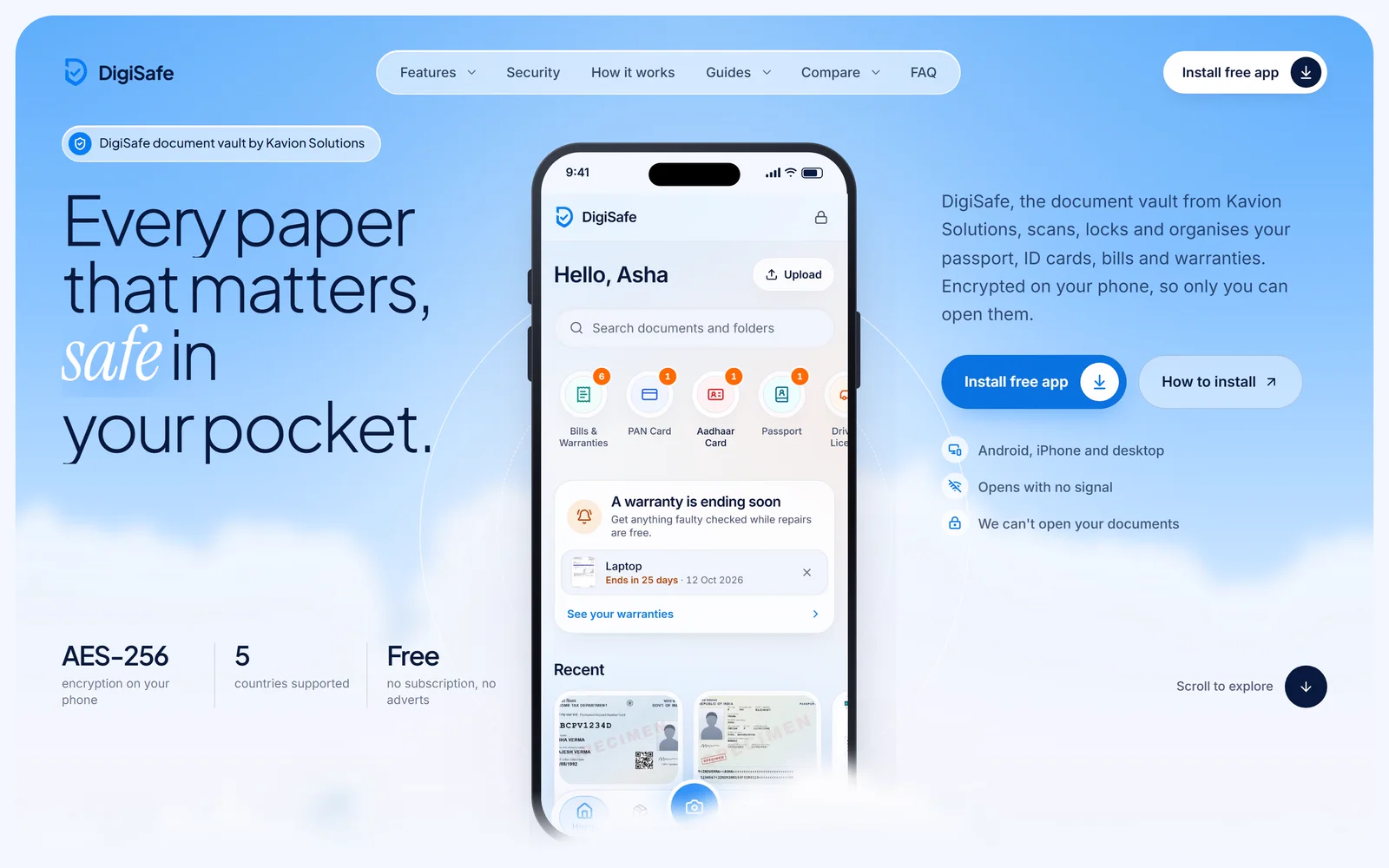
DigiSafe, our free encrypted document vault, is a Kavion product we designed, built and still run. Our advice on scope comes from that, not from theory.
Fixed price, fixed scope
An MVP is the right project for a fixed quote. You know the cost before we start and the milestones you sign off along the way.
AI features when they earn their place
Our team includes an AI engineer, so a chatbot, document reader or smart search can be part of the MVP if it is the reason people will pay.
Room to keep going
After launch you can keep us on a monthly retainer, take on a dedicated developer, or take the code in-house with full documentation.
How it runs
Our MVP development process, from idea to launch
- 01
Discovery
Users, the problem, the one journey to prove and the features that wait. Ends with a written scope and a fixed quote.
- 02
Prototype
A clickable design of the core flow, put in front of real target users and adjusted before code.
- 03
Build in sprints
Weekly preview builds you can use on your own phone or laptop, with a short call to agree what comes next.
- 04
Launch and learn
Store submission or go-live, analytics checked, then a review of what users did in the first weeks.
Cost
How much does SaaS MVP development cost?
Every MVP we take on gets a fixed price after a scoping call. These are the decisions that move it, and most of them are yours to make. Bring your idea and we will turn it into a fixed quote.
Get a fixed quote→| What moves the price | Why |
|---|---|
| Number of core user journeys | One journey done well is the classic MVP. Each extra role or flow, such as a separate admin, vendor or patient side, adds design and build time. |
| Web, mobile or both | A web app alone is the leanest start. Adding iOS and Android through a cross-platform framework adds store setup, device testing and review time. |
| Payments and subscriptions | Stripe checkout is quick. Trials, seats, usage billing, invoices and refunds each add rules that have to be built and tested. |
| Integrations | Every third-party system the MVP talks to, from a CRM to a government API, adds work and a dependency you do not control. |
| AI features | A model call is simple. Answering from your own documents, with sources and guardrails, is a real piece of engineering. |
| Design from scratch or from your files | Starting from a finished Figma file is quicker than doing discovery, brand and interface design together with the build. |
Tools we use for this
- Next.js
- React
- React Native
- Flutter
- TypeScript
- Node.js
- Python
- FastAPI
- PostgreSQL
- Stripe
- Figma
- AWS
- Vercel
FAQ
MVP development questions from founders
MVP development is building the minimum viable product: the smallest working version of your idea that real users can try, and ideally pay for. Startups need it because the biggest early risk is building something nobody wants. An MVP tests that risk for a fraction of the cost of a full product, gives investors something real to use, and turns opinions about your market into evidence from actual behaviour, so the next round of spending goes where users have already shown interest.
The whole route from idea to launch: discovery and scope, a clickable prototype tested with target users, interface design, development of the web app or mobile app, payments, analytics, hosting and the app store submission. We also take on half-built MVPs left behind by other teams. You can use us for all of it or for one part, for example a prototype to raise money with before the full build starts. Every part is handled by the same senior team.
Most focused MVPs take somewhere between eight and fourteen weeks from the start of discovery to launch. A single web app with one core journey sits at the shorter end. Separate user roles, native apps on both stores, complex payments or AI features push it longer. The slowest part is often decisions rather than code, which is why we fix the scope in writing first and show you a working preview every week so nothing drifts.
We give you a timeline with the fixed quote, broken into milestones you sign off, so you know the launch date before work starts. Discovery and the prototype usually take the first few weeks, then development runs in weekly sprints with a preview build you can use yourself. If the scope grows during the build, we tell you what it does to the date and the price before we agree to it, never after.
It depends on how many user journeys and roles the product needs, whether it is web only or also on iOS and Android, how billing works, and which integrations and AI features are in scope. Cutting one non-essential feature often saves more than any discount would. We give a fixed price after a scoping call, and the start a project form lets you pick a budget range so the first conversation is realistic from the outset.
Ours has four stages. Discovery defines the user, the problem and the one journey the MVP must prove, and ends with a written scope and a fixed quote. The prototype stage puts a clickable design in front of target users. The build runs in weekly sprints with preview releases. Launch covers go-live or store submission, analytics checks and a review of how the first users behaved, which shapes what goes into version two.
Start with the web unless the idea depends on the phone itself: the camera, location, push notifications, offline use or a habit people form on their phone. A web app needs no store approval, updates instantly and can rank in search, so it is usually the quickest way to first users. When mobile matters, we build for iOS and Android from one cross-platform codebase so you do not pay for two separate apps.
You do, completely. The repository, cloud hosting, domain, analytics, Stripe account and app store listings are created in your name or transferred to you, and the code is yours from the first commit. That matters for fundraising, because investors and acquirers check it. When the project ends you get documentation and a deploy pipeline, so another team or your own hires can take over without needing us.
The real work starts: watching what users do, fixing what confuses them and deciding what to build next. Most founders keep us on a monthly retainer for that, some take a dedicated developer for steady feature work, and some move the product in-house with our handover documentation. We review the analytics with you after launch so the next sprint is chosen from evidence rather than the original wish list.
Yes. DigiSafe is Kavion's own product, a free end-to-end encrypted document vault that installs on Android, iPhone and desktop, with a document scanner, a number reader, expiring watermarked share links, offline access and one PIN across devices. We designed it, built it and still run it ourselves, so the trade-offs we recommend to founders are ones we have made with our own time and money on our own product.