




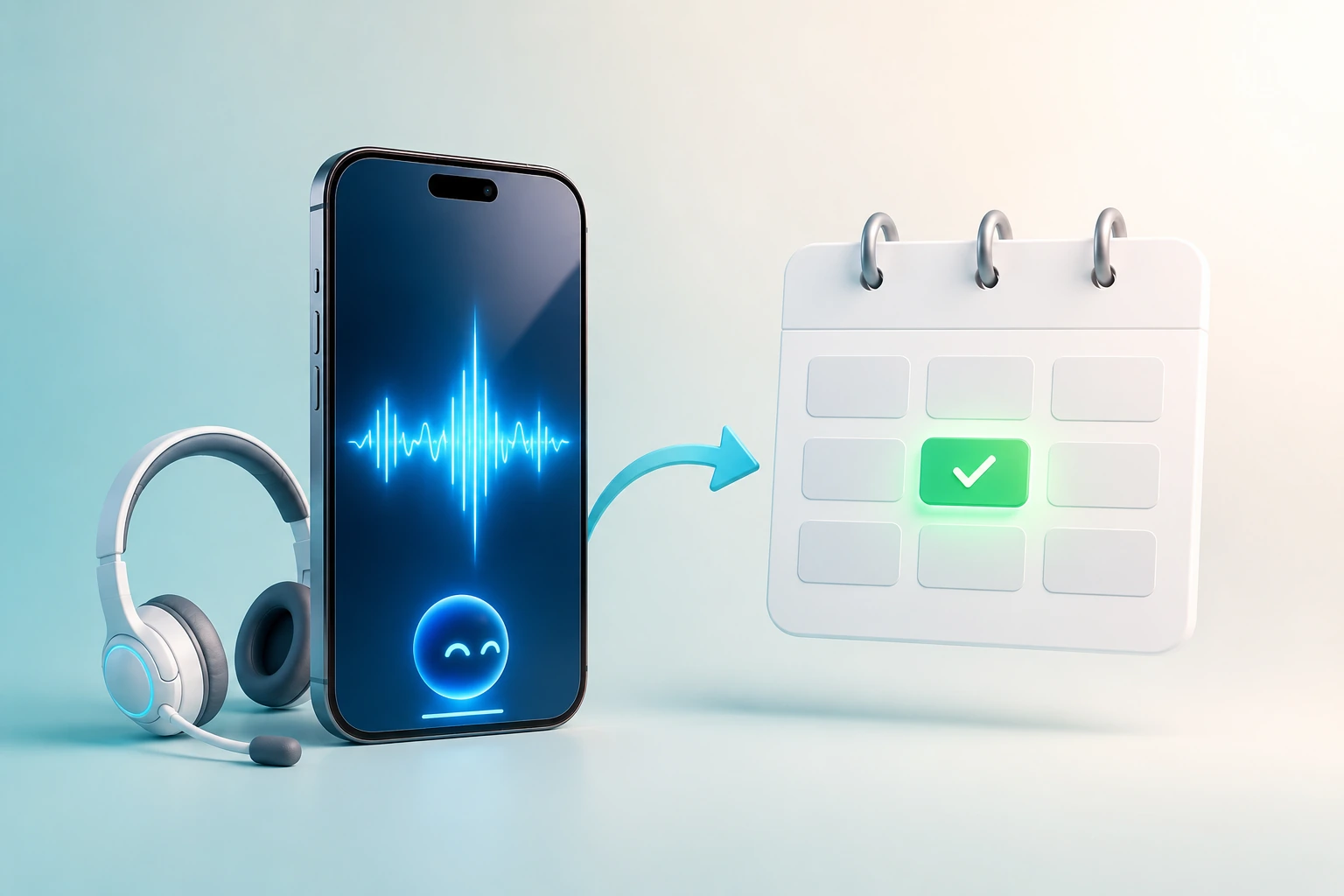
An AI voice agent answers every call, books the appointment and never puts a customer on hold. Here is how it actually works, where it pays off, what it costs, and how to tell if it is right for your business.
Every missed call is a booking that went to a competitor. Most businesses lose a real slice of revenue not because their service is worse, but because no one picked up the phone at 7pm, during a rush, or while the front desk was already talking to someone. An AI voice agent fixes exactly that gap: it answers every call, understands what the caller wants, and books the appointment straight into your calendar, at any hour, without a person in the loop.
What is an AI voice agent (or AI receptionist)?
An AI voice agent is software that answers phone calls and holds a natural, spoken conversation with the caller to get a job done, usually booking, rescheduling or confirming an appointment. People also call it an AI receptionist, an AI phone agent or an AI answering service. Unlike the old press-1-for-sales phone menus, it does not force callers through rigid options. They just speak normally, and it responds like a capable front-desk person who never gets tired and never puts anyone on hold.
The important distinction is agentic versus scripted. A basic voicebot reads a fixed script. A true AI voice agent understands intent, checks real availability, handles the back-and-forth of picking a time, and then actually writes the booking to your system. It does the task, not just the talking.
How do AI voice receptionists work?
Under the hood, an AI voice agent is a real-time loop of a few specialised parts working together in well under a second, so the conversation feels natural rather than laggy:
- Speech to text: the caller's voice is transcribed live as they speak.
- Language model: the transcript is understood in context, the intent is worked out, and the next thing to say or do is decided.
- Tools and data: the agent checks your live calendar, looks up the customer in your CRM, and finds open slots that fit the request.
- Actions: it writes the booking, reschedule or cancellation back into your systems and can trigger a confirmation by SMS or email.
- Text to speech: the reply is spoken back in a natural voice, and the loop repeats until the call is done.
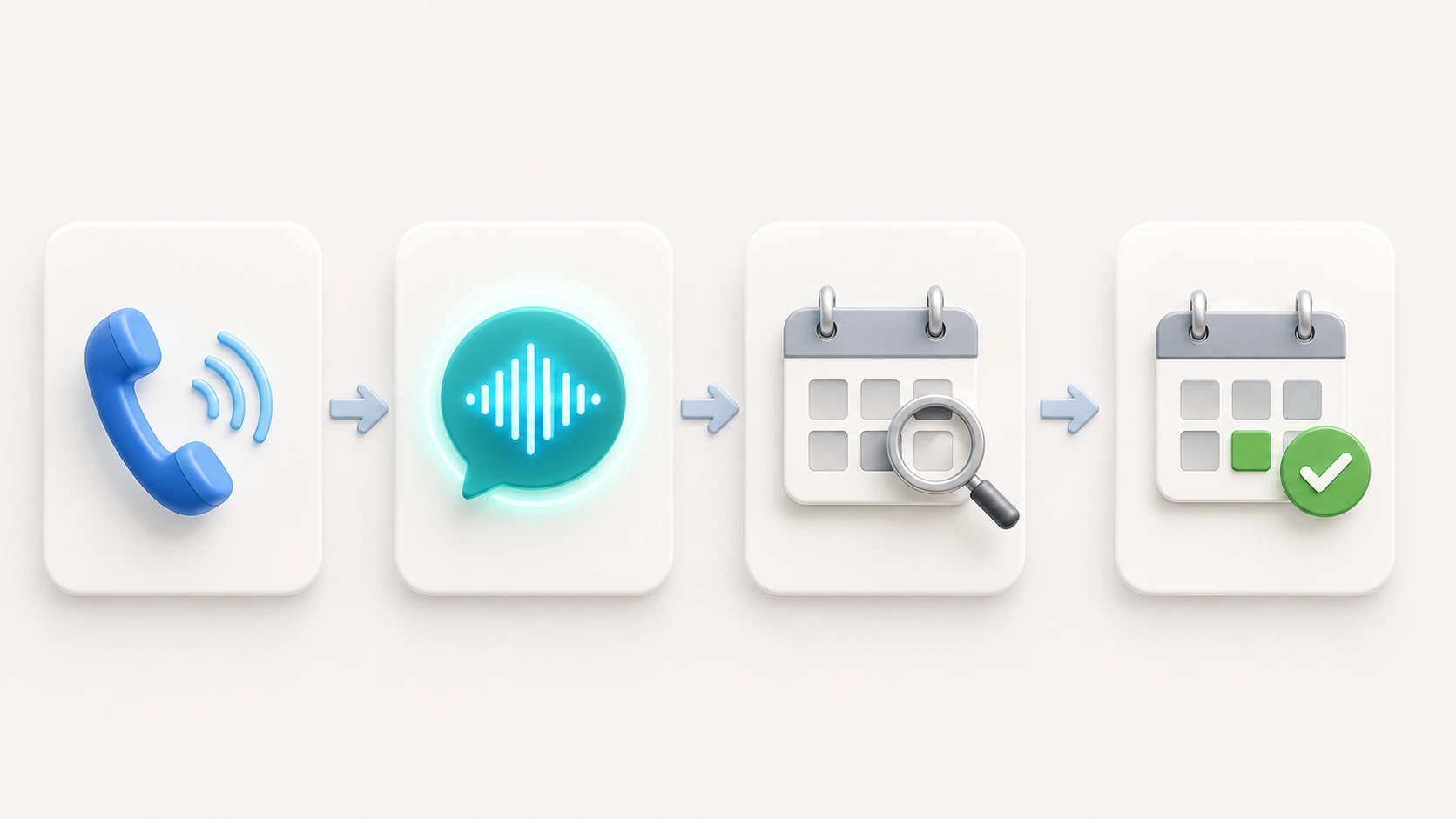
It is a loop, not a script
Speech to text, a language model, your calendar and CRM, then a natural voice back, all in a fraction of a second. The agent understands intent and completes the booking, rather than reading fixed options.
What an AI voice agent can actually do
A well-built voice agent handles the full front-desk job for calls, not just a greeting:
- Book new appointments and read back the confirmed time.
- Reschedule and cancel, then free or fill the slot automatically.
- Route the call to the right person, doctor or department based on what the caller needs.
- Answer common questions: hours, location, pricing, what to bring, parking.
- Send SMS or email confirmations and reminders to cut no-shows.
- Capture the lead and take a message when something genuinely needs a human, then hand it over cleanly.
- Work around the clock, in more than one language, and handle several calls at once during a rush.
“The point of a voice agent is not to sound human for its own sake. It is to finish the booking so a person never has to call back.”
Daksh Bhesdadiya, AI Engineer
Where AI appointment booking makes the biggest difference
Voice agents earn their keep fastest in businesses that are appointment-driven and take a high volume of calls, where a missed call is directly a missed booking:
| Business type | What the agent takes off the front desk |
|---|---|
| Dental & medical clinics | 24/7 booking, rescheduling, reminders, and smart routing to the right doctor |
| Salons & spas | After-hours bookings and cancellations that refill open chairs |
| Home services (HVAC, plumbing) | Capturing emergency and overflow calls that would otherwise go to voicemail |
| Law & professional firms | Screening and scheduling consultations, taking clear intake messages |
| Agencies & sales teams | Qualifying inbound callers and booking discovery calls straight to the calendar |
At Kavion we have built exactly this: a dental appointment system where voice and chat agents handle booking, rescheduling and reminders with conflict-free slotting and smart doctor routing behind them, and a voice-driven scheduling agent that takes a spoken request, resolves the conflicts and writes the calendar event, with no form anywhere in the way.

AI voice agent vs a traditional answering service
Businesses usually compare an AI voice agent against three things they already know: voicemail, a phone menu (IVR), or a human answering service. Here is how they line up on the things that matter:
| Capability | Voicemail / IVR | Human answering service | AI voice agent |
|---|---|---|---|
| Answers 24/7 instantly | Partly | Sometimes, at a cost | Yes |
| Actually books into your calendar | No | Sometimes | Yes |
| Handles many calls at once | No | Limited | Yes |
| Cost per call at volume | Low but loses bookings | High | Low |
| Consistent, on-brand answers | No | Varies | Yes |
What does an AI receptionist cost?
Pricing depends on call volume, how many integrations it needs, and whether you buy an off-the-shelf tool or have a custom agent built around your exact workflow. As a rough 2026 guide:
| Option | Typical cost (USD / month) |
|---|---|
| Off-the-shelf voice-agent tool | $50 to $500 |
| Usage-based platforms | Roughly $0.07 to $0.20 per minute of call |
| Custom-built agent (tailored + integrated) | Setup, then a monthly run cost that scales with volume |
The number that actually matters is not the subscription, it is the bookings you are currently losing. If a handful of recovered calls a week each turn into a booking worth far more than the monthly fee, the agent pays for itself quickly. For most appointment businesses, missed calls are the biggest and most invisible leak, and closing it is where the return comes from.
What to look for when choosing or building one
Not all voice agents are equal. The difference between one customers trust and one they hang up on comes down to a few things:
- Low latency: replies have to come back fast enough that the conversation does not feel robotic.
- Real integrations: it must write to your actual calendar and CRM, not just talk about it.
- Reliable slotting: no double-bookings, correct time zones, and clean handling of conflicts.
- Graceful handoff: when a call needs a human, it should transfer or take a message cleanly, never trap the caller.
- Natural voice and interruption handling: it should let callers cut in and change their mind mid-sentence.
- Privacy and compliance: for clinics especially, data handling has to meet the rules that apply to you.
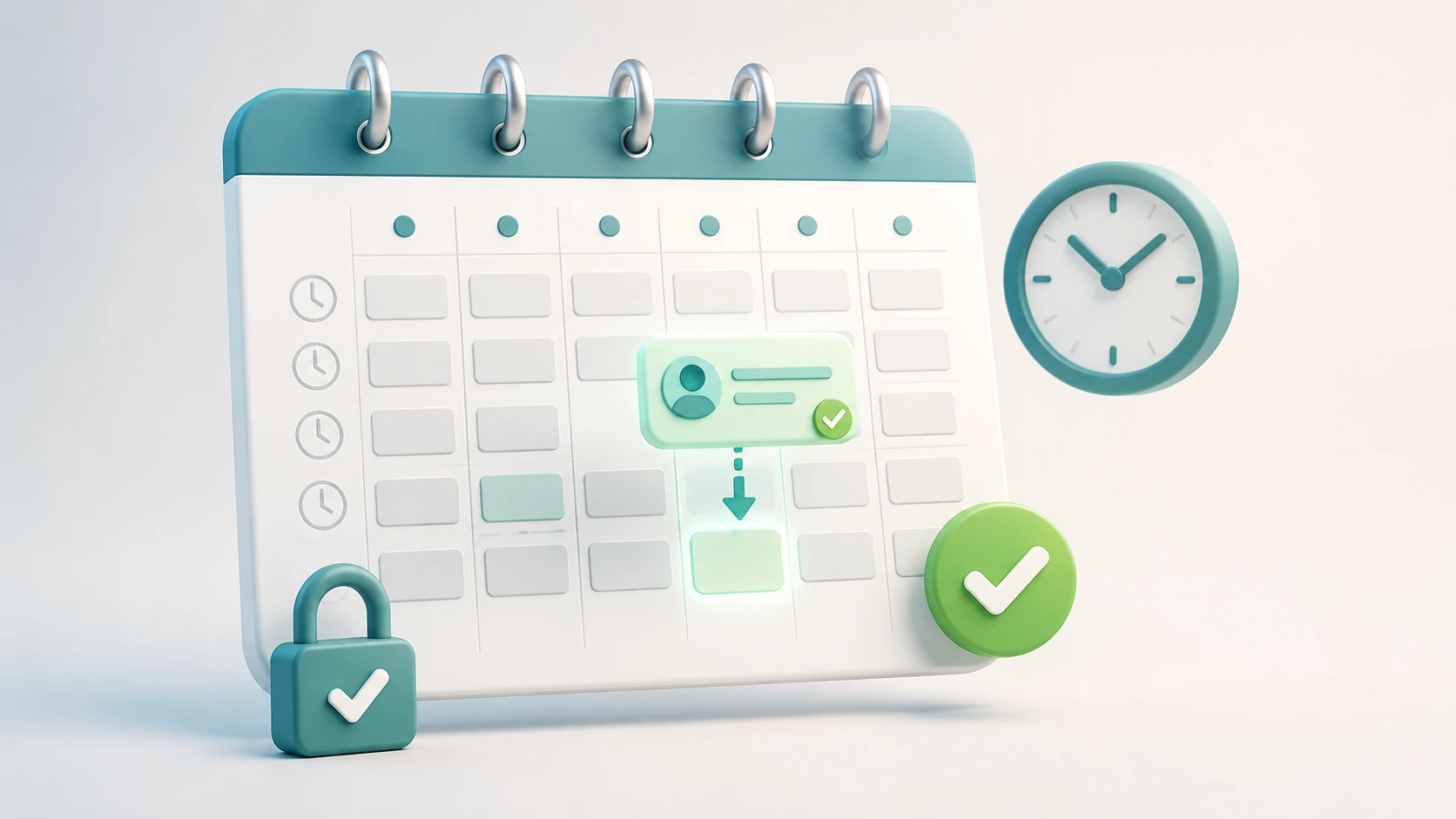
Booking it right is the hard part
Anyone can make an agent talk. The engineering is in writing the booking correctly every time: real calendar and CRM integration, correct time zones, no double-bookings, and a clean handoff when a human is genuinely needed.
Is an AI receptionist right for your business?
If you take enough calls that some go unanswered, and each booking is worth real money, an AI voice agent is likely worth it. If you only get a few calls a week, or every enquiry needs deep human judgement, it matters less. The strongest setup for most businesses is a hybrid: the agent handles the high-volume, repetitive booking and answering, and hands the genuinely complex calls to your team with full context, so people spend their time only where it counts.

Best as a hybrid, not a replacement
Let the agent take the repetitive, high-volume calls around the clock, and hand the genuinely complex ones to your team with full context. People spend their time only where human judgement actually adds value.
The bottom line
An AI voice agent turns your phone line into something that never misses a booking: always on, instant, consistent, and wired straight into your calendar. The technology to do this well, natural voice, real-time reasoning and reliable booking into your systems, is mature enough to run in production today. If you would rather have a voice agent built around your exact workflow and integrated properly with your calendar and CRM, rather than bolting a generic tool onto your phone line, Kavion Solutions builds and deploys these end to end.
FAQ
Frequently asked questions
It transcribes the caller's speech, understands what they want, checks your live calendar for open slots, confirms a time out loud, and writes the booking into your calendar and CRM, then sends a confirmation. All of this happens in real time during the call.
Modern voice agents sound natural and handle interruptions, so many callers do not notice. Most businesses choose to be transparent that it is an automated assistant, which callers accept readily when it books their appointment quickly and correctly.
It replaces the repetitive, high-volume part: answering, booking, rescheduling and reminders, including after hours. It is best used as a hybrid, handling routine calls and handing genuinely complex ones to your team with full context.
Off-the-shelf tools typically run from about $50 to $500 per month, usage-based platforms charge roughly $0.07 to $0.20 per minute, and a custom-built, fully integrated agent has a setup cost plus a monthly run cost that scales with call volume. The return usually comes from the bookings you currently lose to missed calls.
It can be, but it has to be built for it: proper data handling, access controls and compliance with the rules that apply to your industry, such as healthcare privacy regulations. This is a key reason clinics often opt for a purpose-built agent over a generic tool.
Written by
AI engineer at Kavion Solutions working in multi agent systems, LLMs and generative AI. Builds voice and chat agents, hiring automation and RAG pipelines that finish the job end to end.