

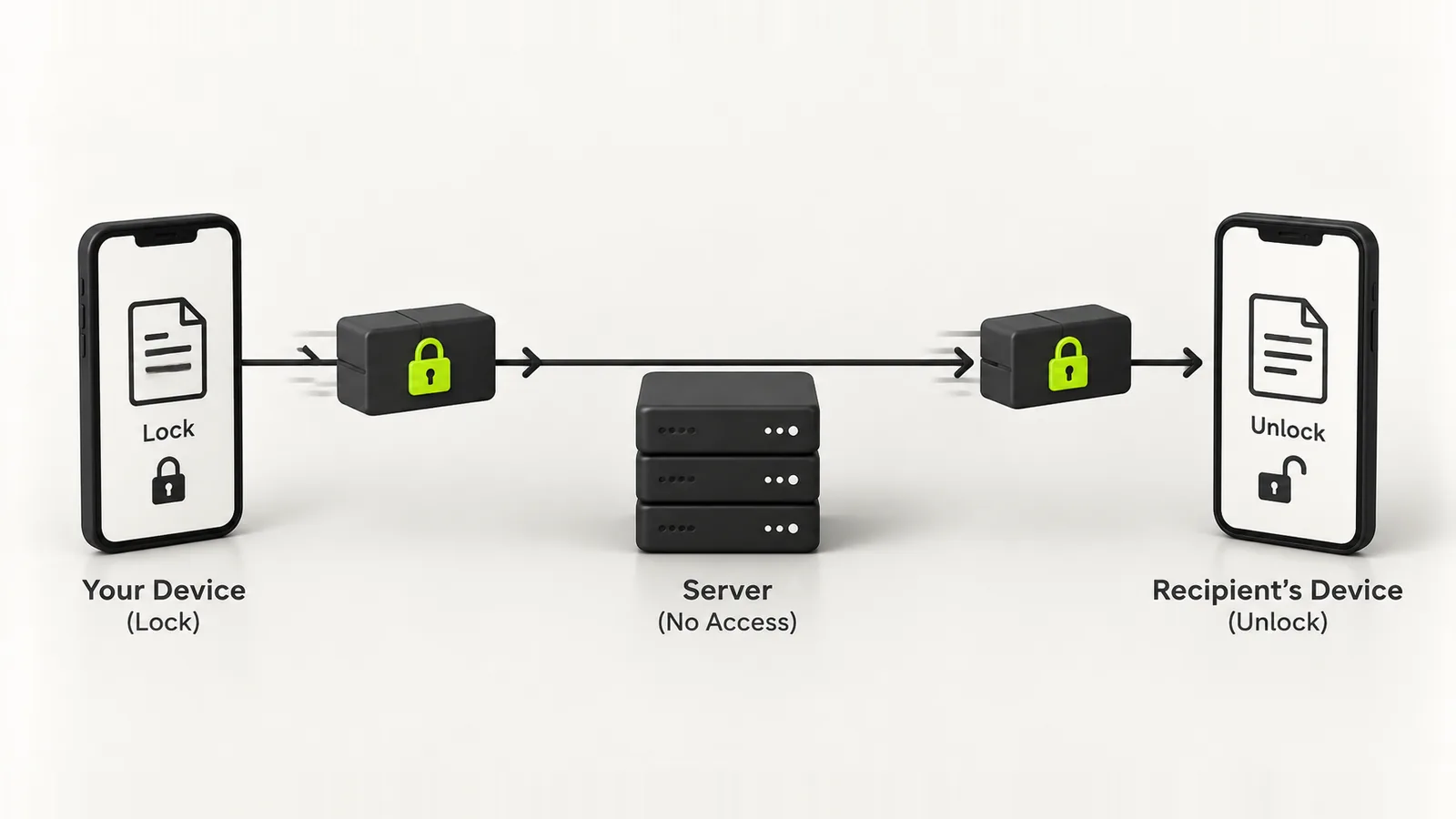
Almost every app now says it is encrypted. Only some are encrypted end to end, and the difference decides whether the company, a hacker or a court can read what you store. Here is what the term actually means, in plain English.
Almost every app now says it is encrypted. Fewer are encrypted end to end, and that difference decides who can read what you send or store: only you and the person you meant, or also the company, anyone who breaches it, and anyone who can make it hand data over.
The one sentence version
End-to-end encryption means your data is locked on your device and can only be unlocked on the device it is meant for, so nobody in between, including the company running the service, can read it.
Encryption in thirty seconds
Encryption scrambles data with a key so it looks like random noise to anyone without that key. Modern encryption is not the weak point. AES-256, the standard used by governments and banks, has no known practical way to be broken by guessing the key. So the real question is never whether data is encrypted. It is who holds the key.
Three kinds of encrypted that are not the same
| Kind | What it means | Who can read your data | Everyday example |
|---|---|---|---|
| In transit | Locked while travelling between your device and a server, unlocked on arrival | The company, and anyone who breaches it | The padlock in your browser (HTTPS) |
| At rest | Stored locked on the company's disks, with the company holding the key | The company, and anyone who gets its keys | Most cloud storage and email |
| End to end | Locked on your device, only unlocked on the intended device | Only you and the intended recipient | WhatsApp and Signal messages, DigiSafe documents |
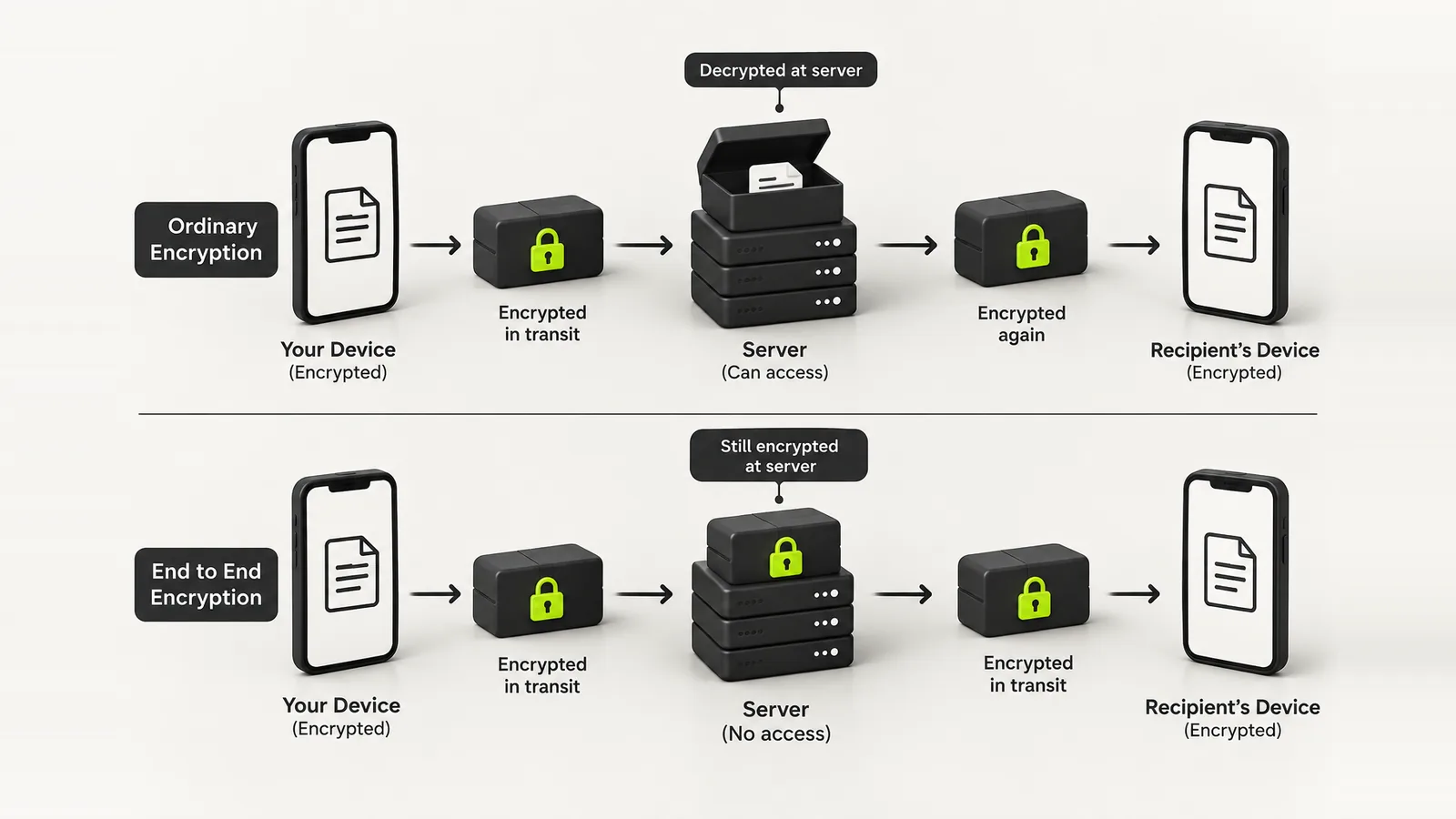
The server is the difference
Ordinary encryption protects the road, then opens the box at the company. End-to-end encryption never opens it in the middle at all.
How end-to-end encryption works
Most messaging apps use public key cryptography. Each device has a pair of keys. The public key can be shared with anyone and only locks. The private key never leaves the device and is the only thing that can unlock.
- When you message someone, your app locks the message with their public key.
- The locked message passes through the company's servers, which can only see noise.
- Only the recipient's private key, on their phone, can unlock it.
- Protocols like the Signal Protocol, used by Signal and WhatsApp, also change keys constantly, so even a key stolen later cannot unlock old messages. This is called forward secrecy.
For files you store for yourself, the idea is the same with one key instead of a pair: the key is made on your device, stays there, and the service stores only what it cannot read. This is sometimes called zero knowledge storage.
Where you already use it
- WhatsApp and Signal encrypt messages and calls end to end by default.
- Apple's iMessage and FaceTime are end to end encrypted.
- Google Messages encrypts RCS chats end to end between Google Messages users.
- Facebook Messenger made end to end encryption the default for personal chats in December 2023.
The catch is backups. WhatsApp chat backups to Google Drive or iCloud are not end to end encrypted unless you turn on the end to end encrypted backup option in settings. On iPhone, iCloud backups are only end to end encrypted if you enable Advanced Data Protection, which Apple withdrew for new users in the UK in 2025. Your messages can be sealed in transit and sitting readable in a backup.
What end-to-end encryption does not protect
It protects the middle of the journey completely. It does nothing for the ends. Knowing the limits is what makes it useful rather than a slogan.
- Metadata. The service may still know who you talked to, when, and how often, even if it cannot read what was said.
- An unlocked device. Anyone holding your unlocked phone sees everything the app shows you.
- Malware on the device, which reads the screen before encryption ever happens.
- The recipient. Once they can read it, they can screenshot it, forward it or save it.
- Weak passwords and PINs, which let someone simply log in as you.
- Unencrypted backups, as above.
“Encryption answers who can read your data on the way. It cannot answer who is holding your phone.”
Kavion Solutions Team
How DigiSafe uses it for your documents
DigiSafe, the free document vault we build at Kavion Solutions, applies end-to-end encryption to identity documents rather than chats. Your PIN is turned into a key on your phone, your documents are locked with AES-256 before they are saved or backed up, and our servers only ever store what they cannot read. We explain the full design, including how the recovery code works, in how we built DigiSafe.
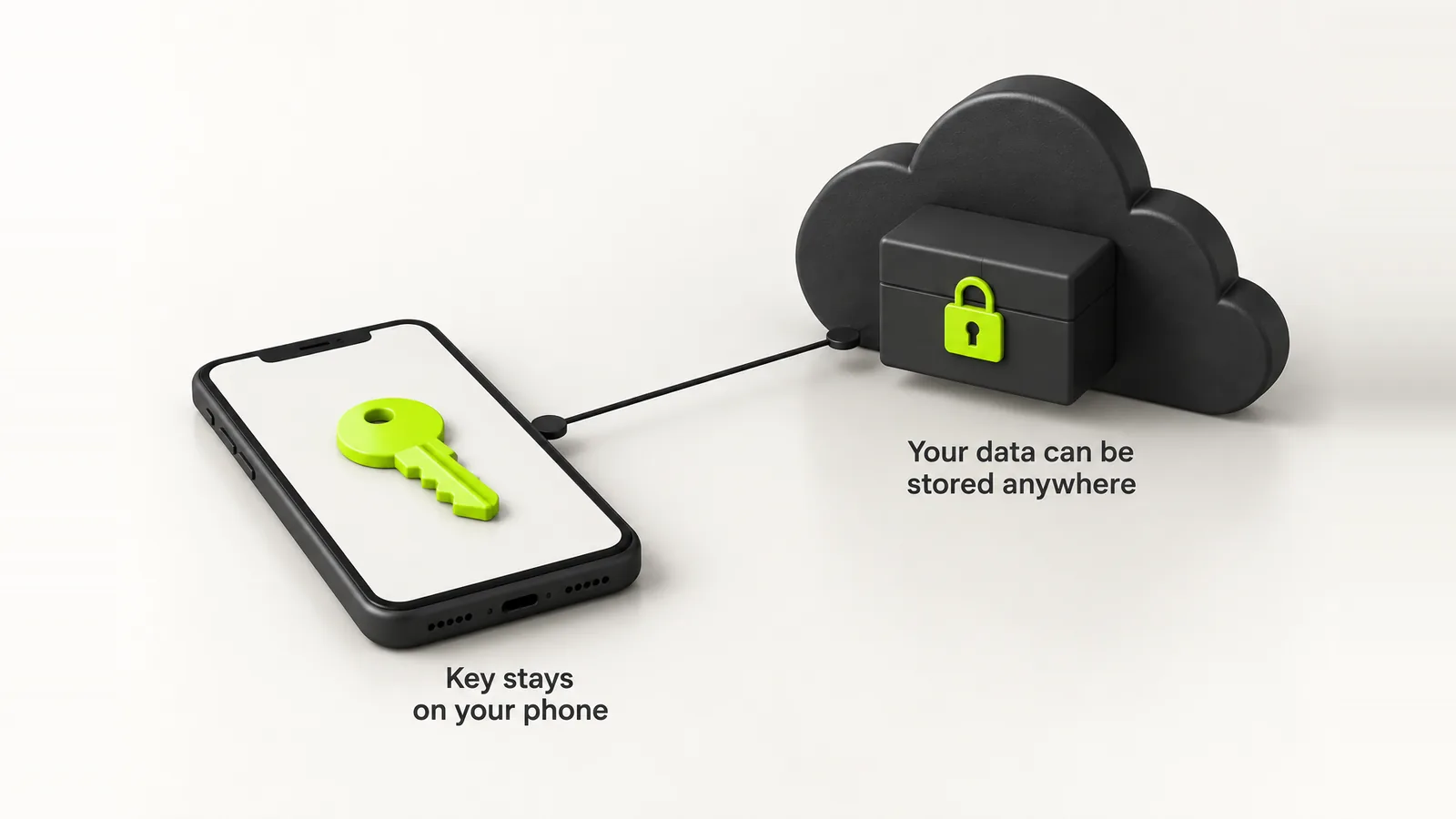
Sharing keeps the same promise. A shared link carries its key after the # symbol, a part of a web address that browsers never send to a server, so the recipient can open the document and the server that delivers it cannot. That is the difference from emailing a passport, where every server along the way holds a readable copy, as we cover in sharing a copy of your ID safely.
How to tell if an app is really end to end encrypted
The label gets used loosely. These questions cut through it:
- Who holds the key? If the answer is not clearly “only your devices”, it is not end to end.
- Can the company reset everything with just your email? If support can restore all your data without your password or a recovery code, the company can decrypt it.
- Is it on by default? Optional encryption that most people never switch on protects most people from nothing.
- Does it explain the design in public? Serious services describe how their encryption works rather than just saying “bank grade”.
- What about backups and sharing? Check that neither quietly falls back to ordinary encryption.
Building software that keeps promises like these is a large part of what we do for clients, from app development to cloud security. The principle is the same every time: decide who must never be able to read the data, then build so that they cannot.
FAQ
Frequently asked questions
It means data is encrypted on the sender's device and can only be decrypted on the intended recipient's device. Nobody in between, including the company running the service, can read it.
Yes. WhatsApp messages and calls are end to end encrypted by default using the Signal Protocol. Chat backups to Google Drive or iCloud are only end to end encrypted if you turn on the encrypted backup option.
No. HTTPS encrypts data between your device and a website's server, and the server can read it on arrival. End-to-end encryption keeps data locked until it reaches the other person's device, so the server never can.
The service provider cannot hand over message content it cannot decrypt. Content can still be obtained from an unlocked device, from unencrypted backups, or from the recipient, and metadata such as who talked to whom may still be available.
The company cannot recover your data for you, because it never had the key. That is why services like this use recovery codes or keys that you keep yourself. Lose both, and the data is unrecoverable by design.
Yes. AES-256 is used by governments, banks and messaging apps, and there is no known practical way to break it by guessing the key. The weak points are usually passwords, devices and backups, not the encryption itself.
Written by
Kavion Solutions Team
The senior team behind Kavion Solutions. We build websites, apps, AI tools and cloud setups, and run the SEO and ads that bring in customers, so everything here comes from work we have actually shipped.
Want this done for you?
Start a project