

The suitcase is the easy part. The paperwork is what stops you at a border, a bank or a university desk. Here is the full document checklist for moving abroad, how to certify it, and how to carry it so nothing gets lost.
Packing the suitcase is the easy part. The thing that actually stops people is paper: the degree certificate still in a cupboard at home, the police clearance that takes six weeks, the bank that will not open an account without a document you left behind. This is the checklist we would want before any move, whether it is India to Canada, the UK to Australia or anywhere in between.
Start three months before you fly
Some documents take weeks to arrive, and some need an official stamp from another office before they are accepted abroad. Police clearance certificates, apostilles, university transcripts and certified translations are the usual bottlenecks. Start there, and leave the easy ones for the last fortnight.
The core checklist
Not everyone needs everything. Tick off what applies to your move, and ask your employer, university or visa office what they specifically require.
Identity and travel
- Passport, valid well beyond your arrival date. Many countries expect at least six months.
- Visa, permit or approval letters, printed and digital.
- National ID and tax numbers from home: Aadhaar and PAN, Social Security card, National Insurance number, SIN or TFN.
- Birth certificate, and marriage or divorce certificates if they apply.
- Spare passport photos in the size your destination uses.
Education and work
- Degree certificates and full transcripts.
- Your job offer or contract, and experience or reference letters from past employers.
- Professional licences or registrations, if your field needs them to be recognised abroad.
- An up to date CV in the format your new country expects.
Money
- Recent bank statements, often needed as proof of funds.
- Tax returns or records from the last two or three years.
- A reference letter from your bank, which can help you open an account or rent a home without local credit history.
- Insurance policies: health, travel and anything you are keeping at home.
Health
- Vaccination records.
- Prescriptions, written with the generic names of your medicines, plus enough supply to bridge the first weeks.
- Summaries of any ongoing medical conditions from your doctor.
Driving, home and family
- Your driving licence, and an International Driving Permit from your home country if your destination asks for one.
- References from your current landlord.
- Children's birth certificates, school records and vaccination records.
- Custody or consent documents if you are travelling with children without the other parent.
- Pet vaccination and microchip records, if a pet is coming with you.
Tick it off before you fly, not at the airport
A missing document costs a day at home and weeks once you have moved. Work through the list early and keep a digital copy of everything you tick.
Certified copies, apostilles and translations
Abroad, a photocopy is often not enough. Institutions want to know a document is genuine, and there are three common ways they check.
| What it is | When you need it | Where to get it |
|---|---|---|
| Certified copy | When an office wants a copy it can trust instead of your original | A notary, solicitor or the issuing institution, depending on the country |
| Apostille | When a public document is used in another country that belongs to the Hague Apostille Convention | The designated authority in the issuing country, such as the Ministry of External Affairs in India or the Foreign, Commonwealth and Development Office in the UK |
| Legalisation | When the destination is not part of the Apostille Convention | Your government's foreign affairs office, then the destination country's embassy |
| Certified translation | When the document is not in the destination country's language | A certified or sworn translator |
India, the USA, the UK and Australia all belong to the Apostille Convention, and Canada joined in January 2024, so documents moving between any of these five usually need an apostille rather than full embassy legalisation. Always check with the office that will receive the document, because some ask for more.
Notes for the five most common destinations
- Canada: keep your confirmation letters and the documents you showed for your permit together, because the officer at the border issues or activates the permit on arrival.
- USA: your I-94 arrival record is online, not stamped, so save a copy after you land. Apply for a Social Security number if you are allowed to work.
- UK: the UK has moved to eVisas, so your immigration status lives in your UKVI account. Keep that login safe and know how to generate a share code for employers and landlords.
- Australia: visas are mostly digital, so keep your visa grant notice, and check your status through VEVO if an employer asks.
- India: if you are returning, or moving there as an overseas citizen, keep your OCI or passport documents together with proof of address from abroad.
How to carry your documents
- Originals go in your cabin bag, never in checked luggage.
- Keep a paper set of copies separate from the originals, so losing one bag does not mean losing both.
- Keep an encrypted digital copy of everything, reachable from any device if your phone is lost.
- Leave a copy with someone you trust at home who can send a document if an office asks.
If something does go missing on the way, our guide on what to do if you lose your passport or ID covers reporting and replacement in all five countries.
Keeping two countries of paperwork straight
The part nobody warns you about is that you now have two sets of papers, and both keep generating more: leases, payslips, tax documents, a new driving licence, warranties for everything you bought in the first month.
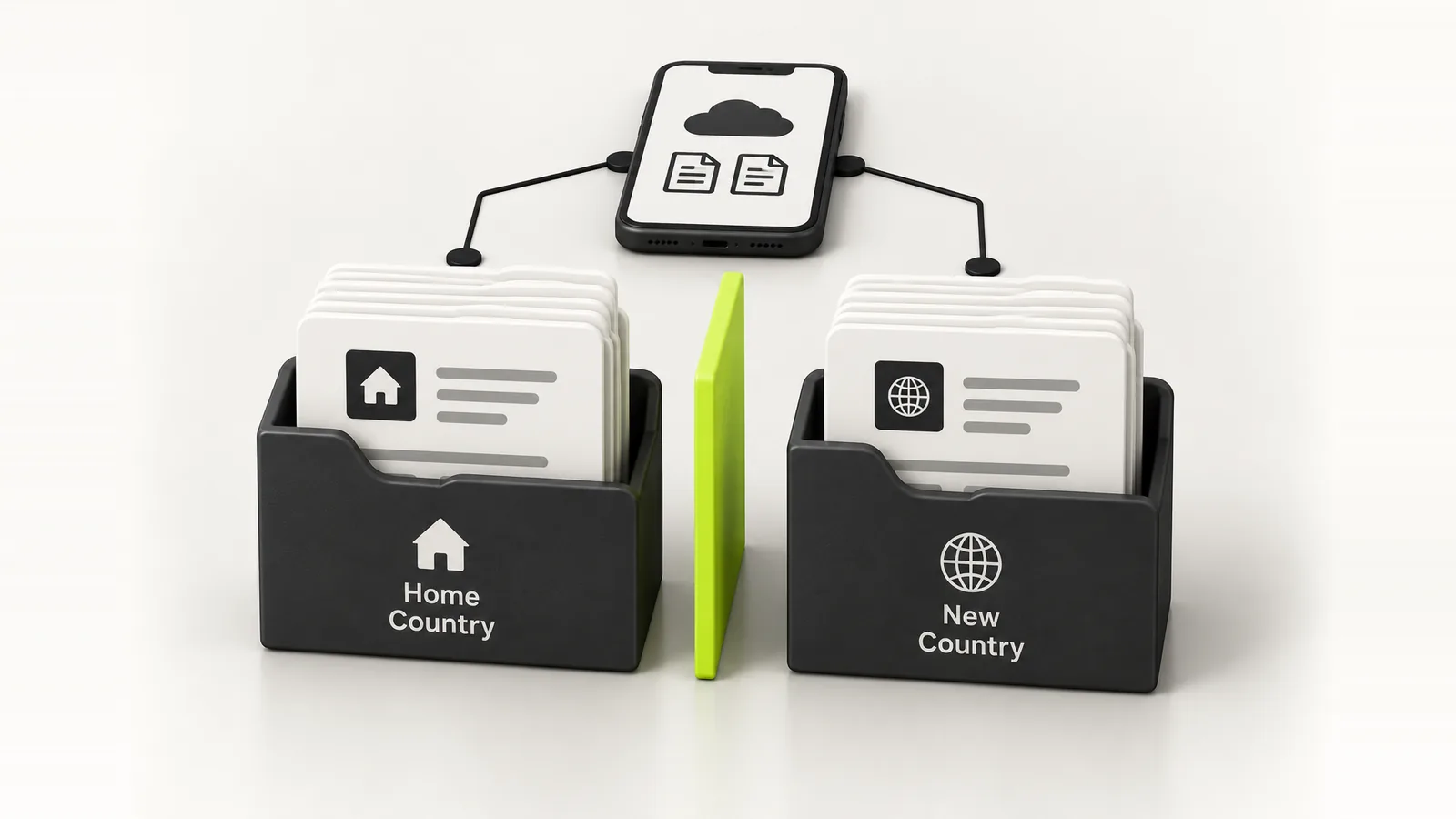
This is exactly why DigiSafe lets you choose two countries, from India, the USA, the UK, Canada and Australia, and gives each its own folders. Ready made document packs show what a big application needs and what you are still missing, warranty reminders catch the dates you will forget, and a family folder keeps everyone's passports in one place. Everything is encrypted on your phone and opens without signal, which matters at an airport.
The first month after you land
- Register your address where it is required, and update it with your bank at home.
- Open a local bank account.
- Get your local tax or social security number, such as an SSN, a National Insurance number, a SIN or a TFN.
- Register with a doctor or the local health system.
- Check how long you can drive on your foreign licence, and whether you need to exchange it.
- Scan every new document the day you receive it.
FAQ
Frequently asked questions
At minimum your passport, visa or permit, birth certificate, education certificates and transcripts, job offer or admission letter, bank statements, and medical and vaccination records. Add marriage certificates, children's records, a driving licence and pet records if they apply.
Take the originals of anything official, in your cabin bag, plus a separate paper set of copies and an encrypted digital copy of everything. Many offices abroad will want to see an original or a certified copy.
An apostille is an official certificate that confirms a public document is genuine, so it is accepted in other countries that belong to the Hague Apostille Convention. India, the USA, the UK, Australia and Canada are all members.
It depends on the destination and how long you will drive on your home licence. Some countries require one alongside your licence, others accept your licence alone for a period. Check before you go, and get the permit from your home country, because you usually cannot get one after you arrive.
About three months before you move. Police clearance certificates, apostilles, transcripts and certified translations can each take several weeks.
An encrypted vault that needs a PIN or fingerprint to open and works offline, rather than your photo gallery or email. That way a lost phone does not mean your documents are exposed.
Written by
Kavion Solutions Team
The senior team behind Kavion Solutions. We build websites, apps, AI tools and cloud setups, and run the SEO and ads that bring in customers, so everything here comes from work we have actually shipped.
Want this done for you?
Start a project